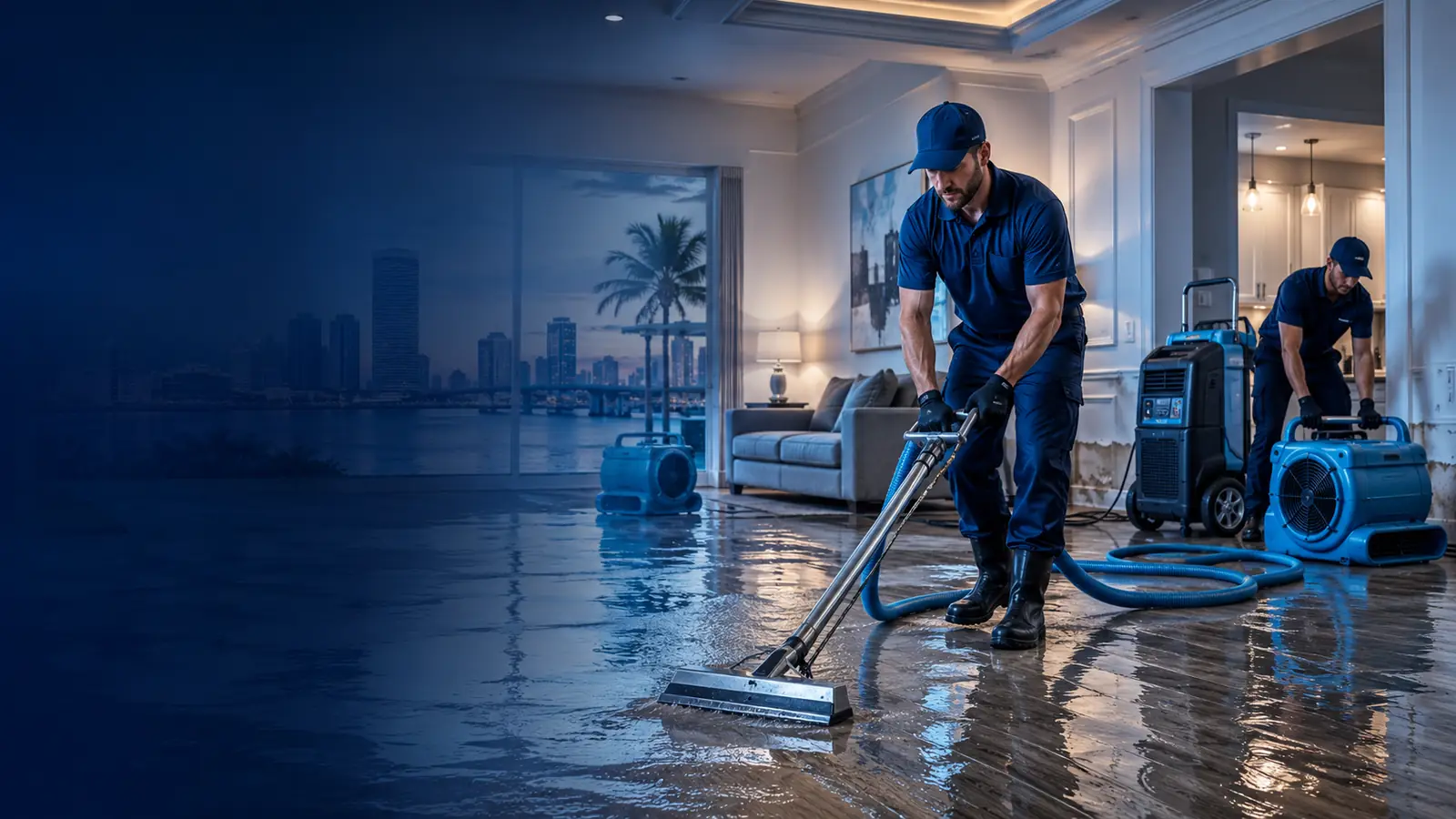
24/7 Emergency Water Damage Response
Water Damage Restoration in Jacksonville, FL
Standing water, a burst pipe, or a sewage backup? Call (904) 925-2370 now.
Why Jacksonville Property Owners Call Us
Straightforward help, clear communication, and practical restoration guidance when water damage happens.
24/7 Emergency Response
Water damage does not follow business hours. Call anytime when you need help with standing water, flooding, sewage backups, burst pipes, or other urgent water damage.
Local Jacksonville Coverage
Providers in this network serve Jacksonville and surrounding communities including St. Johns, Fruit Cove, Mandarin, Ponte Vedra Beach, Nocatee, Jacksonville Beach, Orange Park, Julington Creek, and nearby areas.
Clear Cleanup Plan
You get a plain explanation of what is affected, what should happen first, and the practical cleanup and drying steps, so you understand the process before work moves forward.
Moisture-Focused Drying
Visible water is only part of the problem. The provider process focuses on water removal, moisture checks, airflow, dehumidification, and drying affected building materials.
Residential & Commercial Help
Participating providers assist homeowners, landlords, property managers, offices, and other commercial properties with water damage cleanup and restoration needs.
Multiple Restoration Services
From emergency water extraction and flood cleanup to sewage cleanup, structural drying, mold remediation, storm damage restoration, and fire-and-water cleanup, the site covers a wide range of restoration needs.
Need Help With Water Damage?
Tell us what happened and get practical next-step guidance for your Jacksonville property.
24/7 Water Damage Restoration Across Jacksonville
Water Damage Gets Worse Every Hour It Sits
Water damage restoration in Jacksonville FL is a race against humidity. Drywall wicks water upward, carpet pad holds several times its weight, and in this climate microbial growth becomes a realistic concern within roughly 24 to 48 hours. Emergency water removal in the first hours is what keeps a wet room from becoming a water damage repair and rebuild project: extract the standing water, define the wet perimeter with meter readings, and dry the structure before materials fail.
Providers answer emergency calls around the clock and arrive with extraction and drying capacity on the truck, so mitigation starts on the first visit instead of a follow-up appointment. From there the work is measured: moisture mapping to define what is actually wet, drying to a documented standard, and cleaning and repair for the materials that could not be saved.
Core Services
Extract, Dry, Clean, Remediate, Restore
Emergency response first, then drying, then the cleaning and repair work that follows. Every service below is available 24/7 across the Jacksonville area. Most Jacksonville calls start with emergency extraction; from there the job becomes structural drying, contaminated-water cleanup, mold remediation, or fire and water damage cleanup, depending on what the readings show.
The five services homeowners here ask for most are emergency water extraction and water removal, flood cleanup and flood damage restoration, sewage cleanup and sewage remediation, structural drying and dehumidification, and mold remediation and mold removal.
Fire & Repairs
Roof Leak Water Damage Repair
Roof Leak Water Damage Repair for Jacksonville homes, handled as part of the full water damage restoration scope.
View service →Emergency Response
Emergency Water Extraction
Rapid removal of standing and trapped water so drying can start before materials are lost.
View service →Flood & Sewage Cleanup
Flood Cleanup
Cleanup after rising and street flooding, including silt removal, disinfection, and structural drying.
View service →Flood & Sewage Cleanup
Sewage Cleanup
Category 3 sewage backup cleanup with containment, removal, disinfection, and verified drying.
View service →Emergency Response
Burst Pipe Repair
Locating and repairing failed supply lines, then extracting and drying everything the water reached.
View service →Structural Drying
Structural Drying
Monitored drying of framing, subfloor, and wall cavities until readings prove dry standard was reached.
View service →Mold Remediation
Mold Remediation
Contained mold removal, HEPA cleaning, and correction of the moisture source that allowed growth.
View service →Fire & Repairs
Fire & Water Damage Cleanup
Post-fire cleanup that handles smoke, soot, and the suppression water left behind, in one coordinated scope.
View service →Emergency Response
24/7 water extraction, burst pipe response, and rapid stabilization of a wet building.
Flood & Sewage Cleanup
Flood water removal, sewage and black water cleanup, disinfection, and removal of contaminated materials.
Structural Drying
Metered drying plans, dehumidification, hardwood and subfloor drying, and moisture mapping to a documented dry standard.
Mold Remediation
Containment, HEPA filtration, removal of affected porous material, testing, and correction of the moisture source.
Fire & Repairs
Roof leak water damage, fire and water cleanup, smoke and soot cleanup, and odor removal.
Planning Tool
Water Damage Restoration Cost Calculator Jacksonville FL
Wondering how much water damage restoration may cost in Jacksonville? Use this estimator to get a rough planning range based on the size of the affected area, water source, materials involved, and complexity of the cleanup.
8 of 8 inputs selected
Timeline Tool
How Long Will Water Damage Take to Dry?
Structural drying time varies depending on how much water entered the property, which materials became wet, humidity, airflow, and how quickly professional drying begins.
6 of 6 inputs selected
Cost Drivers
What Affects Water Damage Restoration Cost?
People searching for water damage restoration cost in Jacksonville FL usually want to know what moves the number up or down. These are the factors that shape water extraction cost and the total cleanup on a real job.
Affected square footage
The larger the wet footprint, the more extraction passes, air movers, and dehumidifiers the job needs, which is the single biggest driver of water damage cleanup cost.
Water source and category
A clean supply-line leak costs less to remediate than contaminated water. Sewage or grey water requires containment, antimicrobial treatment, and disposal of porous materials.
Flooring and drywall
Carpet and pad often dry in place, while wet drywall may need flood cuts. Hardwood needs specialty mat drying, which raises both cost and timeline.
Cabinets and insulation
Toe kicks, cabinet boxes, and wet insulation hold moisture long after surfaces feel dry, so they frequently require controlled removal and rebuild.
Standing water
Standing water adds truck-mount water extraction cost and means the subfloor, sill plates, and wall cavities have likely absorbed moisture too.
Drying equipment and duration
Equipment is billed per unit per day, so how many air movers and dehumidifiers run — and for how many days — shapes the final invoice.
Demolition requirements
Any removal of baseboard, drywall, flooring, or insulation adds labor, debris disposal, and reconstruction to the scope.
Contamination and mold
Musty odor or visible growth moves the job into mold remediation with containment, negative air, and HEPA filtration.
How quickly restoration begins
Costs climb hour by hour. Materials that stay wet past 48 hours are far more likely to need replacement than materials dried the same day.
For scope specifics, see residential water damage restoration, emergency water extraction, flood cleanup, and mold remediation.
Drying Factors
What Affects Water Damage Drying Time?
How long water damage takes to dry — including how long wet drywall takes to dry — comes down to physics: water volume, material porosity, humidity, airflow, temperature, and dehumidification.
Amount of water
Minor moisture in a single room can be dry in a couple of days; standing water that soaked into subfloor and wall cavities takes considerably longer.
Material type
Wet drywall commonly takes about three to five days with proper airflow, while hardwood and cabinetry can take a week or more even with mat systems.
Indoor humidity
Northeast Florida humidity slows evaporation. Dehumidification has to pull the ambient grain depression down before materials will release moisture.
Airflow
Air movers placed at the right angle across wet surfaces are what convert trapped moisture into vapor the dehumidifiers can capture.
Temperature
A stable, warmer indoor temperature speeds drying; unconditioned or closed-up spaces stall the process.
Dehumidification capacity
Undersized equipment simply moves moist air around. Correct capacity for the cubic footage is what shortens the drying window.
How long materials stayed wet
The longer the delay before professional drying starts, the deeper moisture migrates — and the longer the structural drying period runs.
Learn how daily readings are documented on structural drying in Jacksonville FL and how providers respond on burst pipe repair calls.
Emergency Response
Water Still Coming In?
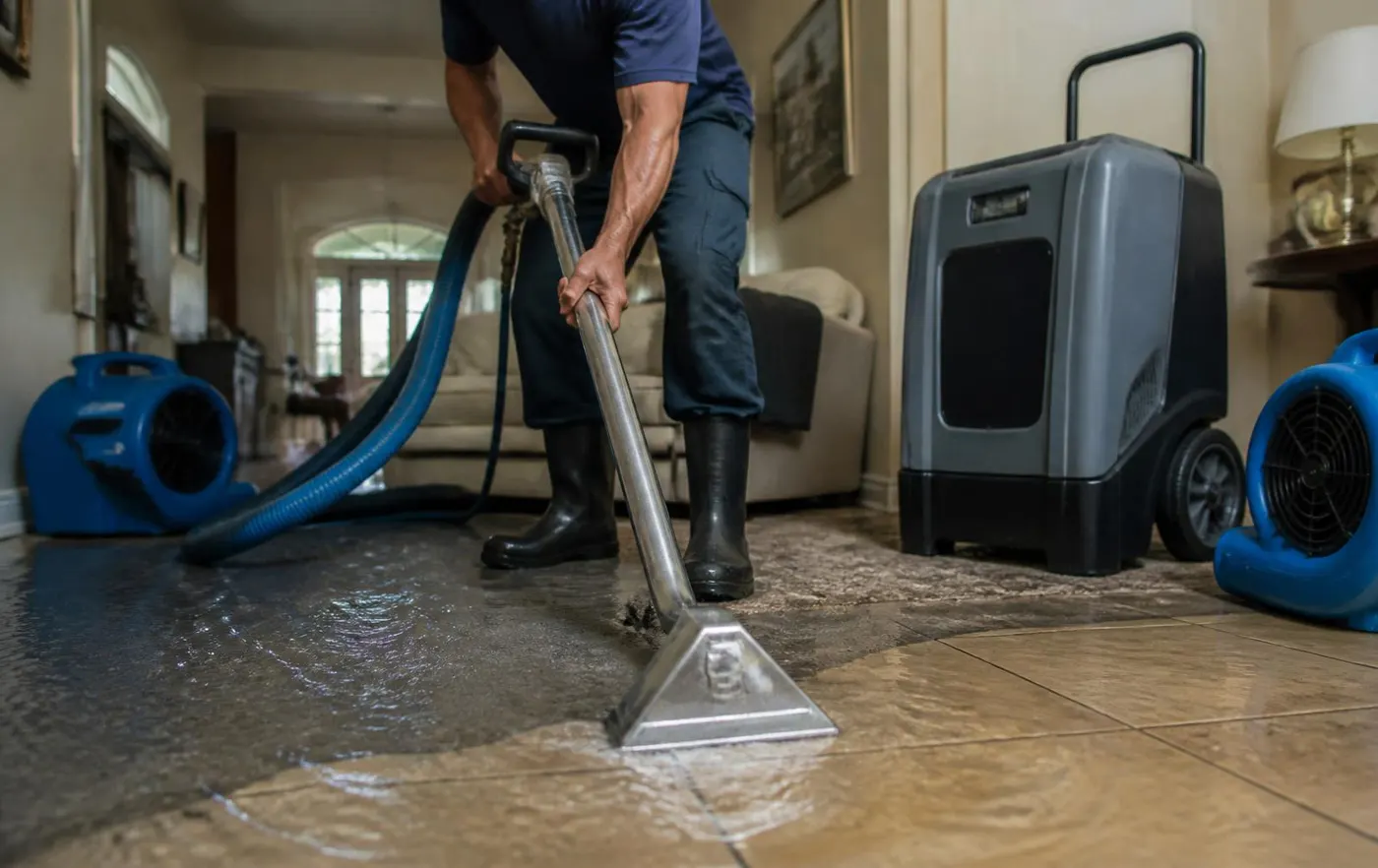
A burst supply line, a failed supply hose, a sewage backup, or rising water pushing under a door all share the same first hour: stop the source, cut power to wet areas, extract standing water, and photograph everything before anything moves. Calls are answered around the clock, and requests are matched to independent providers covering Duval, St. Johns, and Clay County addresses with extraction units, air movers, dehumidifiers, and moisture meters on the truck.
Good jobs begin with a moisture map rather than a guess: perimeter readings, wall cavity checks, subfloor and slab readings, and a written scope tied to those numbers. That is what keeps demolition limited to what the data justifies and what makes the claim straightforward when your adjuster asks why a material came out.
Full Restoration Scope
Water Damage Restoration in Jacksonville, FL: The Whole Process
The water damage restoration process step by step
Every water damage restoration project follows the same sequence so nothing gets skipped under time pressure. The order matters more than the speed: decisions made in the first hours determine how much of the building has to be rebuilt later.
- Source control and safety check Participating providers confirm the water is stopped, check for electrical hazards near standing water, and identify the category of water before anyone starts moving contents.
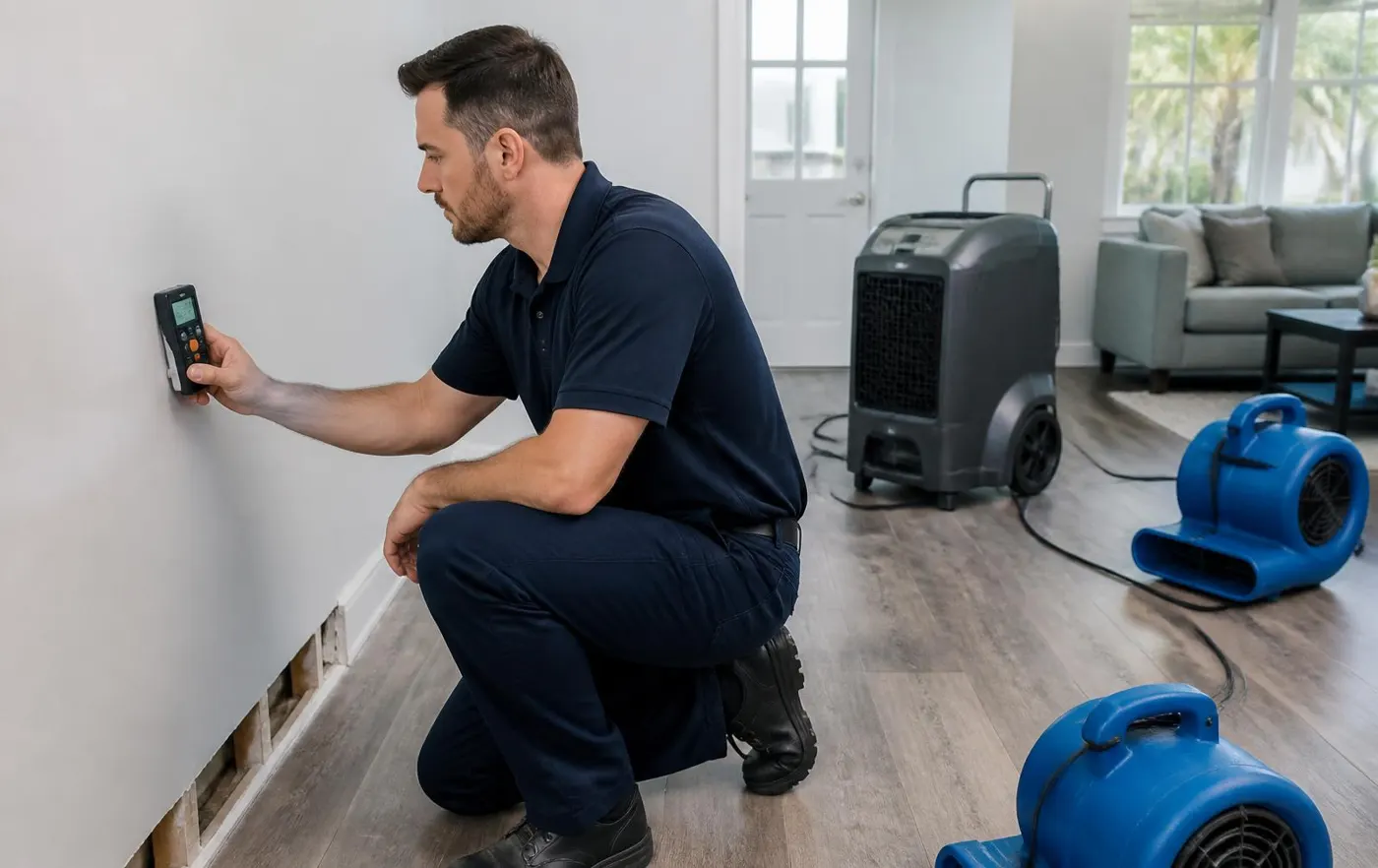
- Moisture mapping Meters and thermal imaging define the wet perimeter, including the cavities and adjacent rooms that look untouched but read wet.
- Extraction Truck-mounted and portable extraction removes standing and trapped water from hard surfaces, carpet, and pad so drying can actually begin.
- Selective removal Materials that cannot dry in place, such as wet insulation, saturated pad, and swollen particle board, come out along documented cut lines.
- Structural drying Air movers and dehumidifiers are set to the affected volume, then adjusted daily against readings rather than left on a timer.
- Cleaning, disinfection, and rebuild Salvageable surfaces are cleaned and treated, and the finish work closes the openings the crew made once each material meets dry standard.
Equipment and measurement providers rely on
Every job runs on measurement. Pin and pinless moisture meters read wood and drywall, thermo-hygrometers track grain per pound in the affected space against an unaffected control room, and thermal imaging narrows where to probe. Those numbers set the drying goal at the start and prove it was reached at the end.
Equipment is sized to the space, not the truck. Low-grain refrigerant dehumidifiers handle most Jacksonville interiors, desiccant units come out for dense assemblies like hardwood over plywood, and negative-pressure containment is used whenever providers cut materials in an occupied home.
How long water damage restoration takes
The first day is about stopping the loss from spreading: extraction, removal of unsalvageable materials, and equipment placement. Most homeowners see the biggest visible change in these first hours, because standing water is gone and contents are off wet flooring.
Days two and three are quieter and more important. Readings are taken at the same points every visit, dehumidifiers are adjusted, and the drying curve either flattens or keeps dropping. A flat curve tells us a cavity is holding water and needs another access point.
Most residential losses reach dry standard in three to five days. Dense assemblies, hardwood, and multi-room losses run longer, and providers would rather add a day of drying than close a wall over a marginal reading.
What can be dried and what has to come out
The split between salvage and removal is decided by material type, water category, and how long the material stayed wet. Non-porous and semi-porous materials — framing, plywood, concrete, tile, solid wood — usually dry successfully when clean water is extracted the same day. Porous materials that absorbed contaminated water do not, regardless of how good they look.
Providers make that call at the readings, then document it. Every removed item is photographed and logged with the reading that justified it, which is what keeps a scope defensible with an adjuster and keeps homeowners from paying for demolition that moisture data did not support.
- Almost always dried in place Framing lumber, plywood and OSB subfloor, concrete slab, ceramic tile, solid hardwood caught early.
- Usually removed Carpet pad, wet fiberglass and blown insulation, particle board and MDF cabinet boxes and trim.
- Depends on the reading Drywall, plaster, engineered flooring, and cabinetry — clean-water losses caught early often dry, contaminated ones do not.
- Always removed after contamination Anything porous that contacted sewage or outside flood water, including drywall bottoms, pad, and soft goods.
What not to do while you wait for a crew
Waiting is the hardest part of a water loss, and it is where well-intentioned decisions cause damage. Do not walk through standing water before the power to that area is off. Do not run a shop vacuum across sewage or flood water. Do not start pulling baseboard, cutting drywall, or lifting flooring before the wet perimeter has been mapped, because the cuts often end up in the wrong place.
Do keep the air conditioning running, do get contents up off wet floors, and do save receipts for anything you buy to limit the damage. Carriers routinely reimburse reasonable emergency expenses when there is a receipt to attach.
- Do not enter standing water with power on Cut the breaker to affected areas first.
- Do not vacuum contaminated water Sewage and flood water require protective equipment and proper disposal.
- Do not start demolition Cuts made before the wet perimeter is mapped usually have to be extended anyway.
- Do keep receipts Emergency expenses are commonly reimbursable with documentation.
Why Homeowners Call Us
A Documented Drying Standard
24/7 emergency dispatch
Calls are answered around the clock, including overnight and weekends, when most large losses actually begin.
Extraction on the first visit
Trucks carry extraction and drying equipment so mitigation starts immediately rather than at a second appointment.
Readings, not guesswork
Moisture meters, thermo-hygrometers, and thermal imaging define the wet perimeter and set the dry standard providers work to.
Dry in place where possible
Materials that readings show can be saved are dried rather than demolished, which keeps the rebuild scope smaller.
Claim-ready documentation
Dated photos, moisture maps, daily readings, and equipment logs are gathered from the start for your adjuster.
Straight answers about coverage
Local restoration providers tell you when a loss is a flood claim, when it is wind, and when nothing needs to be done at all.
Property Types
Residential Water Damage Restoration in Jacksonville, Florida
Most requests here in Jacksonville, Florida are for single-family homes, townhomes, condos, and rental properties — places where a dishwasher hose, AC condensate line, roof leak, or upstairs toilet overflow sends water through living spaces fast. The residential process providers follow is built around occupancy: contain the wet areas, protect furniture and flooring, extract standing water, and dry wall cavities and subfloors without tearing out more than the moisture map justifies.
The standard to expect on any home is the same: documented drying, containment barriers, and a written scope tied to moisture readings, so demolition stays limited to what the data justifies and the claim stays clean.
What to expect on a residential call
- Target arrival in 60–90 minutes for active leaks and flooding, subject to provider availability
- Moisture mapping of every affected room and cavity
- Protected containment so unaffected spaces stay dry
- Coordination with your insurance adjuster
- Final walk-through with meter readings before sign-off
Choosing a Contractor
How to Choose a Water Damage Restoration Company in Jacksonville
When water is still spreading, the decision often comes down to who answers first and who shows up with the right equipment. Look for a Jacksonville water damage restoration company that answers 24/7, documents moisture readings before demolition begins, and explains the drying plan in plain language. Insurance carriers prefer detailed scopes; vague estimates and gut-feel demolition slow claims and drive up out-of-pocket costs.
Ask three questions before signing: Are you licensed and insured for restoration work in Florida? Will you provide a written drying plan with daily moisture logs? Do you bill insurance directly or work with adjusters on the estimate? A clear yes to all three is the fastest way to separate a qualified local operator from an out-of-town crew.
Service Area
Where Coverage Extends
Participating providers dispatch to twelve core communities across Duval, St. Johns, and Clay County, plus the surrounding neighborhoods. Each one has its own water damage pattern — second-floor plumbing in newer subdivisions, cast iron drain failures in older neighborhoods, tidal flooding along the river, and wind-driven rain at the coast.
Pick your area below for local detail on the losses providers see there, the construction providers work in, and how quickly providers can reach you.
About
About Water Damage Restoration Jacksonville
This site is a free way to reach a Jacksonville water damage restoration provider, built around one idea: the scope should follow the readings. Meters, hygrometers, and thermal imaging decide what comes out and what gets dried in place, which means you are not paying for demolition that moisture data does not support.
That approach shapes everything else. Local restoration providers answer the phone at three in the morning because the first hours matter most. Providers document from the first visit because that file is what settles a claim. And providers tell you plainly when a loss is a flood claim rather than a homeowners claim, or when a stain turns out to be historic and nothing needs to be done at all.
Requests are matched with independent providers covering Jacksonville and the surrounding Duval, St. Johns, and Clay County communities. Calls go to (904) 925-2370 at any hour, and email reaches us at info@waterdamagerestorationjacksonvillefl.com.
FAQ
Common Water Damage Questions
How fast can you respond to water damage in Jacksonville?
- Providers answer calls 24/7 and dispatch immediately for active losses. Call (904) 925-2370 and providers bring extraction and drying equipment on the first visit, because the first few hours decide how much of the building can be saved.
How long does it take to dry a house?
- Most residential losses reach dry standard in three to five days. Hardwood, slabs, tile over plywood, and dense assemblies run longer, and providers verify with daily readings against an unaffected control area rather than working to a fixed schedule.
Will insurance cover my water damage?
- Sudden and accidental water damage is generally covered by Florida homeowners policies. Water rising from outside the building is a flood claim, and long-term seepage is usually excluded, so providers document the entry path and condition at discovery carefully.
Do I need to move out during drying?
- Usually not for a contained clean-water loss. Sewage contamination, extensive mold work, and fire losses are different, and providers tell you upfront when staying is not a good idea.
Should I open the windows to help it dry?
- No. Outdoor air in Jacksonville usually carries more moisture than the air providers are drying, so the building stays closed and dehumidification does the work.
Can I just dry it myself with fans?
- Fans move surface water into the air, but without dehumidification that moisture condenses somewhere else in the house. Wall cavities, subfloors, and insulation are the parts that need equipment and readings.
What areas do you cover?
- Jacksonville and eleven surrounding communities across Duval, St. Johns, and Clay County, including St. Johns, Fruit Cove, Mandarin, Ponte Vedra Beach, Nocatee, Jacksonville Beach, and more.
Call (904) 925-2370 for 24/7 emergency water damage response anywhere in the Jacksonville area.
Request emergency serviceSame-day and 24/7 emergency services are subject to provider participation, location, technician availability, and demand. Availability is not guaranteed and may vary by market and appointment capacity.